

How Can I Help My Anxious Child or Teenager?
By Will Sessions, BACP-accredited psychotherapist and SPACE provider
When your child or teenager is struggling with anxiety, it can be really hard to know what to do to help them. Do you reassure them? Encourage them to face the thing they're afraid of? Give them more time? Push a little? Back off? Find them a therapist?
Parenting an anxious child or teen is hard and needs a different approach that maybe no one's taught you - yet.
It doesn't matter whether your child has generalised anxiety, social anxiety, separation anxiety, school refusal/emotionally based school avoidance or OCD, the most effective ways to help them are the same.
Start by understanding what anxiety is
Anxiety is a normal part of the human experience. We're wired with an alarm system to let us know when we're in danger so we can react and stay safe. Just like the smoke alarm you have in your house, it will go off to let you know something's burning.
Anxiety becomes an issue when our alarm system isn't able to distinguish whether the alarm's gone off because of the toaster or because there's a fire. Or maybe we know it's just the toast but we can't get it to stop beeping. That alarm system is primal and most of the time it's keeping your child safe.
You can't logic your way out of anxiety. Even if cognitively you know the chance of the thing you're afraid of really happening is tiny, your alarm system is still telling you you're not safe.
Your child can't control that alarm going off.
Anxiety compels your child to act (or not act)
Anxiety wants certainty and safety. It tells your child to avoid the presentation, stay home from school, check one more time, ask you for reassurance or sleep in your room. Their whole system is telling them they'll be in danger if they don't.
Doing those things often works in the short term and reduces your child's distress. But by avoiding the thing that's making them feel worried, their brain gets confirmation that there really was a danger. They don't get the chance to learn that there wasn't, or to learn that they can tolerate their difficult feelings.
Helping an anxious child isn't about making them feel less distressed in the moment.
It's about helping them become more able to cope with feeling anxious.
Listen to their fear without treating it as fact
An anxious child needs to feel heard and understood, but that doesn't mean you have to agree with everything anxiety is telling them.
There's a real difference between:
“Don't worry. I promise nothing bad will happen.”
and:
“I can see you're really worried about this. I know it feels difficult and I believe you can handle it.”
The first response tries to remove the uncertainty. The second communicates two things at once - acceptance and confidence.
Notice how much you reassure
Reassurance is one of the most natural things we do as parents.
If your child asks:
“Are you sure I'm not going to be sick?”
“What if I fail the test?”
“Are you sure you checked the door?”
“Do you promise I'll be okay?”
of course you want to make them feel better.
Occasional reassurance isn't a problem. But when reassurance becomes something your child needs repeatedly, it can become part of the anxiety cycle. They feel worried, seek reassurance, feel better temporarily and then need reassurance again when doubt returns.
If this is happening frequently in your family, it can be more helpful to gradually change how you respond rather than continuing to answer the anxious question over and over.
[Read more: Should I reassure my anxious child?]
Notice what your family has changed because of anxiety
Parents often make allowances and changes because of their child's anxiety. You might:
speak for your child because they're too anxious to answer
repeatedly reassure them that something bad won't happen
let them avoid places or activities that make them anxious
change family plans because your child can't tolerate them
sleep beside them because they can't sleep alone
check things repeatedly on their behalf
allow them to stay home from school when anxiety becomes overwhelming
organise family life around preventing their distress
We call these changes 'accommodations'.
Accommodations can be helpful in the moment, and they can sometimes be helpful longer term to support your child in being able to take steps, but they can unintentionally send the message
“You can't cope with this unless I make the anxiety go away for you.”
It's helpful for anxious children when accommodations are made with the big picture in mind of helping them build skills and confidence.
[Read more: What is family accommodation?]
Don't remove every difficult situation
Avoidance is another very understandable response to anxiety. If something makes your child extremely distressed, of course you want to be compassionate and let them say no to it. And sometimes that's the most helpful response.
But if anxiety repeatedly determines what your child can and cannot do, their world can get smaller. They might stop seeing friends, going to parties or sleepovers, stop activities, stop going to school - and become increasingly reliant on you.
Teenagers are supposed to be exploring the world and who they're going to be in it, which involves trying new things and taking risks. When anxiety is in charge, their focus is on staying safe instead of on growing.
Supporting them to take risks doesn't mean throwing them into situations they're completely overwhelmed by. But it also doesn't mean waiting until they feel confident before they do difficult things.
[Read more: Should I let my anxious child avoid things that scare them?]
How much should I push my anxious child?
This is one of the hardest judgements for parents. Push too hard and your child might feel completely overwhelmed or misunderstood. Never challenge anxiety and it might increasingly dictate what they can and can't do.
It's important to communicate confidence in your child's ability to cope while making changes at a level your family can realistically sustain. That will look different depending on the situation and how anxious they feel about it.
[Read more: How much should I push my anxious child?]
What if my child gets angry when I stop helping?
When you've adapted around anxiety, changing those patterns might initially increase your child's distress. They might plead, argue, meltdown, become angry or tell you that you don't understand.
That doesn't automatically mean the change is wrong.
Right now your child doesn't believe they can cope without the accommodations you've been making for them and their alarm system goes into overdrive.
Reducing accommodations usually works better for all involved when it is planned - and it has to be paired with increased emotional support.
Is my child's anxiety my fault?
Parents often wonder whether they did something to cause their child's anxiety. Were they too anxious themselves, too protective, too strict, too permissive..
There isn't one simple cause of childhood anxiety, and having an anxious child doesn't mean you've caused it.
The real impact parents have on their children's anxiety is in helping them with it. The research is also clear on that.
You can have an important influence on what happens with your child's anxiety without being the reason the anxiety developed in the first place.
[Read more: Is my child's anxiety my fault?]
What if my child refuses therapy or doesn't want help?
Many children are unwilling or unable to engage with therapy for a variety of reasons. That might make you feel stuck, but your child's participation isn't the only route to change.
A therapist will be with your child for 1 hour a week, you're with them the other 167 hours - which puts you in the best place to help them.
Parent-based treatment approaches help you change your responses to anxiety. With SPACE, parents learn how to respond more supportively to anxiety while gradually reducing the accommodations that might be helping anxiety maintain its hold. In a randomised clinical trial, SPACE was shown to be as effective as CBT at reducing children’s anxiety symptoms.
[Read more: My child refuses therapy — what can I do?]
What if we're waiting for CAMHS?
Being on a waiting list can leave you feeling like you're in limbo until you reach the front of the queue. But there are things you can do while you're waiting.
Understanding avoidance, reassurance and accommodation can help you identify the patterns happening in your own family and think differently about how you respond.
Parent-led support can begin without waiting for your child to start individual therapy and is also complementary to it.
[Read more: What can I do while my child is waiting for CAMHS?]
What actually helps an anxious child?
There isn't one sentence, script or parenting technique that helps handle anxiety. There are certainly things you can say and do in the moment that look like they're helping - but those strategies usually involve avoiding whatever's triggering it which brings relief in the short term but doesn't actually help your child learn the skills they need to handle their discomfort or distress.
A useful starting point is to ask yourself "Am I helping my child learn that they can cope with anxiety, or am I increasingly organising things so they don't have to experience it?"
Supporting an anxious child often means learning to:
listen without dismissing their fear
communicate confidence in their ability to cope
reduce repeated reassurance
recognise avoidance
identify family accommodations
change the accommodations that are keeping the family stuck
tolerate some of your child's distress without immediately trying to remove it
The key is becoming more supportive while becoming less accommodating.
When should I get professional help for my child's anxiety?
Anxiety is part of being human and all children experience it. It might be worth seeking additional support when anxiety is significantly interfering with everyday life, for example, school, friendships, sleep, independence, eating, family relationships or activities your child previously managed.
You might also want support simply because you no longer know how to respond.
You don't have to wait until things are at crisis point to learn different ways of helping.
Parents can be part of the solution
You don't have to control your child's thoughts or persuade them not to feel anxious - you can change the part of the system you do have control over: your own responses.
Research into SPACE shows that a completely parent-based intervention can reduce childhood anxiety without the child participating directly in treatment.
That gives you another route forward, particularly if your child or teenager is unwilling or unable to engage in therapy themselves.
Find out more about SPACE
SPACE is an evidence-based parent treatment for childhood and adolescent anxiety and OCD. It teaches parents how to increase supportive responses while gradually reducing the accommodations that can keep anxiety in charge.


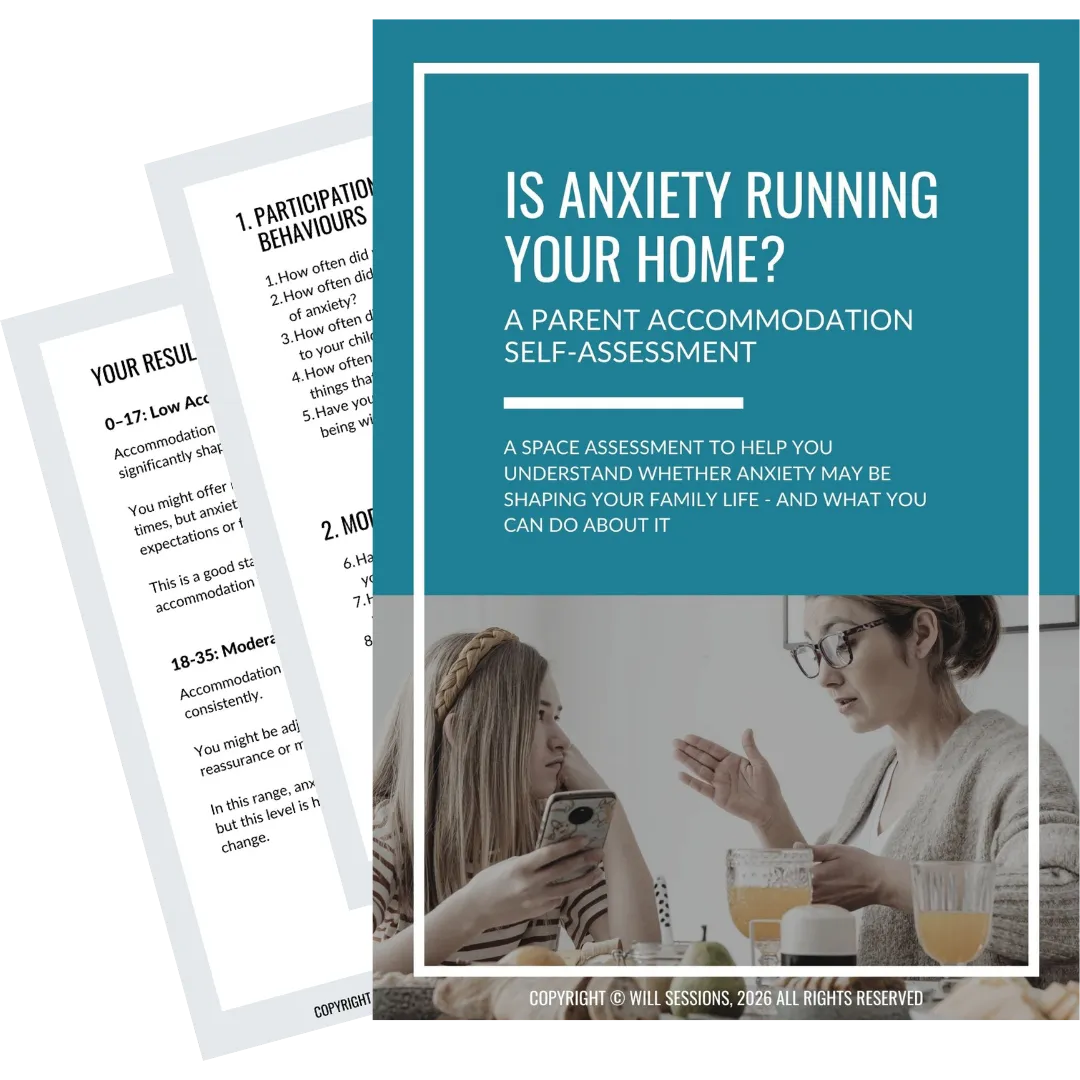
Is Anxiety Running Your Home?
Sign up below to get our free SPACE self-assessment and discover whether accommodation may be keeping your child stuck - and what you can do about it
Is Anxiety Running Your Home?
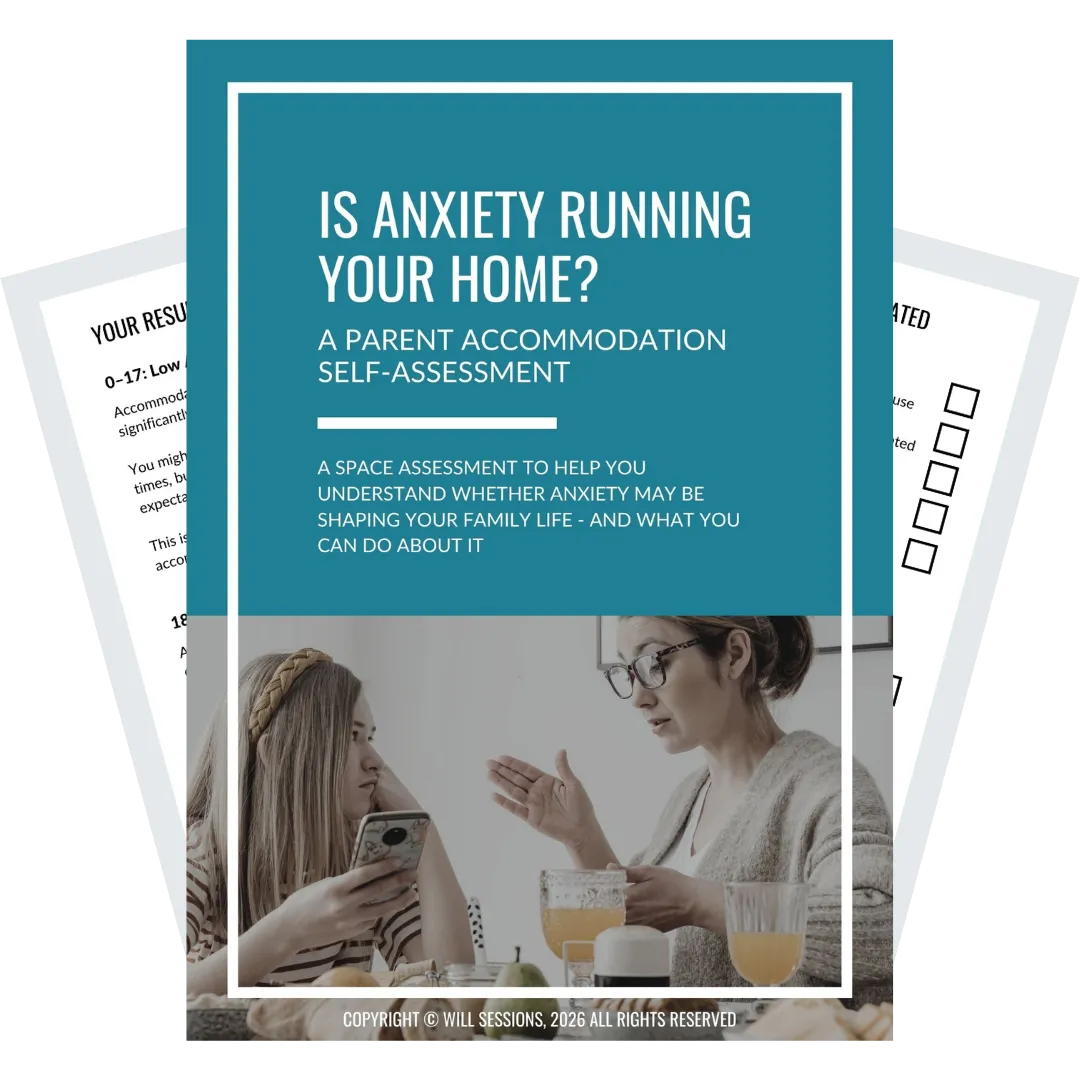
Sign up below to get our free SPACE self-assessment and discover whether accommodation may be keeping your child stuck - and what you can do about it
© Will Sessions 2026 All Rights Reserved